by Cheyenne Tait – I believe that a big part of being a scientist is being ready and willing to share your knowledge and passion with others. I was also inspired by the other members of NICE lab and their recent outreach activities with students in Sikkim and Bangalore. So I seized an opportunity to travel back to my own high school in the Catskill Mountains of New York state, to take over the high school biology class for two days near the end of their school year. They’d just finished talking about evolution, adaptation, and Darwin’s finches. So it was the perfect time to introduce them to the system I work in: the Rhagoletis genus of fruit flies.
It’s a topic that I could talk about for hours. Rhagoletis is a system containing various sibling species that evolved via either allopatric or sympatric mechanisms, with complex contributions from ice ages, parasitoids, and host-associated adaptations, amongst many other factors. But rather than simply talk, I gave the biology students the barest introduction to the flies, then had them try to recreate the evolutionary relationships of the genus, first only with the wing patterns, then knowing the host plant and biogeography of each species, then with mock genetic sequence information. And by the end, with all types of data, thinking and investigating like real biologists, they actually got close to the currently accepted phylogeny.
After they accomplished that, we took our workshop outside to the playground, and split into groups to create evolutionary trees of the birds – in chalk on the blacktop. They discovered that it was much more difficult with this expanded group of more distantly related organisms. Ultimately, no one’s tree was right or wrong, not with the little evidence that they had been given (pictures of the birds and some natural history). More importantly, they learned firsthand about the collaborative process of making and rejecting hypotheses.
Going back to my high school, teaching in the very same classroom where I first heard about Darwin’s finches approximately 10 years ago, was strange but exciting. Discussing the process of science with young people, especially the often misunderstood phenomenon of evolution is important. It wasn’t something that objectively needed to be done: their teacher was there and would have used the days to review for finals. However, in my opinion, yes, it was needed and yes, I would do so again.
Thanks to Mr. Ed McGee and his curious, enthusiastic 9th and 10th grade biology students for two awesome days of evolutionary biology!


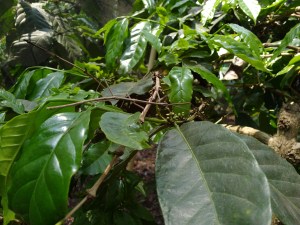 by Sriraksha Bhagavan- Here is the beautifully camouflaged stick insect that freaked me out while I was searching for a beetle on a coffee plant. This was my first encounter with a stick insect!! As I moved closer to the insect, it moved to and fro rhythmically, pretending as if it were a twig swaying in the wind (this strategy helps in confusing its predators). It made me appreciate the difficulties its predator would have to face in order to spot this guy visually. Also, these creatures disprove the famous expression that it takes “two to tango”, as the females have the capability to continue their progeny without the involvement of a male (also known as parthenogenesis).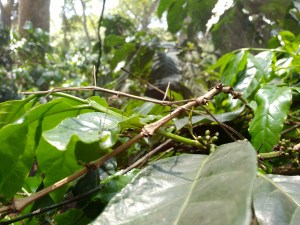

 by Santosh Rajus – Working on the Coffee White Stem Borer, observing them in the field in their modified ecosystem, and my recent observation of a huge gathering of beetles feeding on the secretion from tree barks ,makes me wonder, what happens to the insects when we modify their ecosystem? How do they find their host? How far do they go in search of their host?
 We all know that insects play a very important role in our ecosystem. Insects are really good at playing their part and I think modifying their ecosystem just puts them in a puzzle. A few insects may be able to solve this puzzle, thus making them survive in large numbers and eventually making them a PEST. Citing this example of the Coffee white stem borer; how their natural hosts were removed, leading them to choose the Coffee plant, how they adapted to using this plant as a host and eventually becoming a pest in the coffee plantations; leads me to several questions – What made these borers choose the coffee plant? Did the beetle get attracted to coffee because it had features similar to its previous host or is it simply just the lack of availability of other hosts? Hope I get my questions answered soon.




 NICE
NICE 