

Here is an interview at the Central Drug Research Institute in Lucknow on chemical ecology, natural products, and India! It was given during the brain-storming meeting on “Renewing the tradition of natural product research in India” held on 21-23 Jan 2016.
A pile of twig is all a Bagworm needs!!
by Sriraksha Bhagavan – Want to construct a house which you can carry anywhere you go? ask the Bagworm moth larvae which makes a home using twigs and pieces of leaves and carries it where ever it goes.
During our field work in Coorg I found something strange, I noticed a pile of tiny wood logs arranged one above the other like a tower on a Arabica plant leaf, when I went closer to it I saw this tower moving and started clicking pictures!! I took it on my hand and found some tiny larvae like thing inside it and I was not sure what it was. After some search I found that it was a Bagworm moth larvae.


Inspiration….
Apparently comes to @NCBS_Bangalore in many forms….

Virtual Reality
Check out this amazing photo from Pavan showing a tethered apple fly in pursuit of a virtual apple. In addition to the tether, you can see the lighting used to monitor wingbeat amplitude and the inlet for the air flow, creating a “virtual wind”.

The ‘Paper Architect’
by Sriraksha Bhagavan – I believe that there is nothing more fascinating than to observe these tiny little engineers in nature. These tiny little engineers have a complex yet highly efficient system that will never ‘crash’ or ‘shut-down’ due to the unavailability of any modern technology.
I found these ‘Paper Architects’ on my staircase railings, they are the common Indian paper wasps (Ropalidia marginata), and they are eusocial and build their nest by chewing wood pulp and mixing it with their saliva. Unlike honeybees they do not have castes distinguishable by common physical characteristics.
While I was observing the cells of this nest I found different stages of development, what fascinated me was the wasp had kept its young ones in a much organised manner, the eggs were placed singly in each cell and at the bottom were the youngest and new eggs and on the top were the developing pupae. One of the females was very watchful and was patrolling the nest from top to bottom.
Even though I was very close to their nest, the wasps were tolerant to my presence, and went about their business without stinging me!!


Snapshot
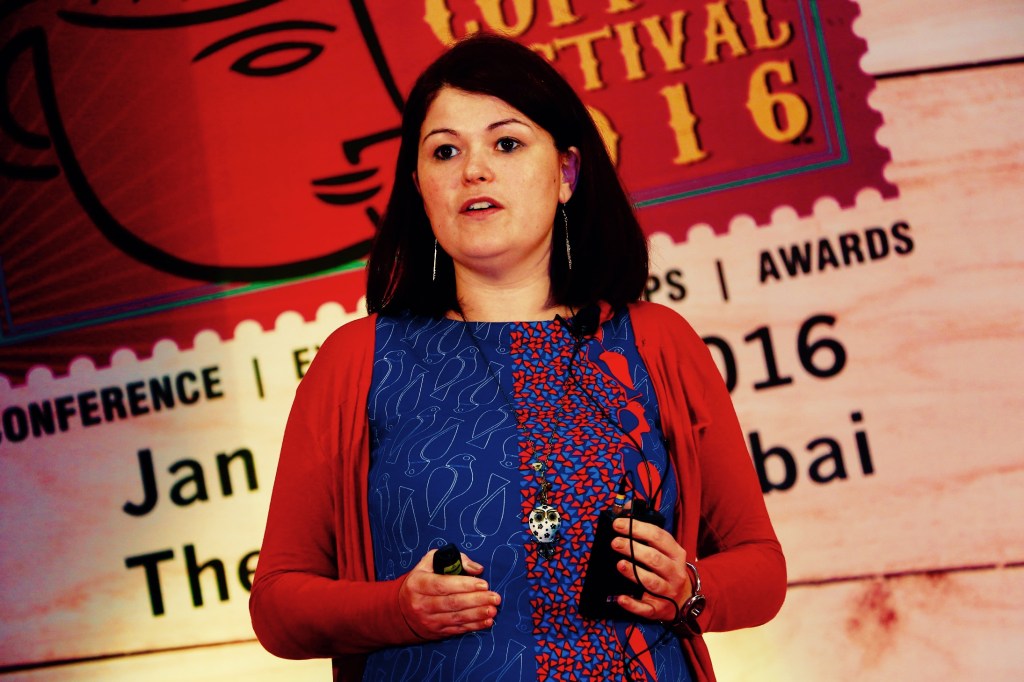
Shannon speaking about our research on the coffee white stem borer at the India International Coffee Festival in Mumbai January 23, 2016.
Mimicry at its best! Kerengga Ant-like Jumper
by Santosh Rajus – The weaver ants are one of the most effective and aggressive killers, destroying almost everything on their way, from caterpillars to beetles. They live in big colonies and patrol the plant from top to bottom in search of food. But there seems to be a certain insect which has mastered the art of avoiding getting killed by the weaver ants; the Kerengga Ant-like jumper (Myrmarachne plataleoides).
This spider exhibits sexual dimorphism. The male, being slightly bigger in size and with an extended jaw, looks like it is carrying a dead Weaver Ant; which is a very common sight on trees with Weaver Ant colonies. This spider mimics the Weaver Ants in locomotion and hunting patterns, thus enabling it to avoid becoming prey. But sometimes, the spider does come into contact with the Weaver Ants and still manages to get away without getting harmed.
Observing this adaptive nature of the Kerengga Ant-like Jumper, a few questions arise: how does the spider escape even after getting in contact with the weaver ant? How is the spider mimicking the chemical cues?
As always, nature keeps surprising us!


Welcome Pavithra!
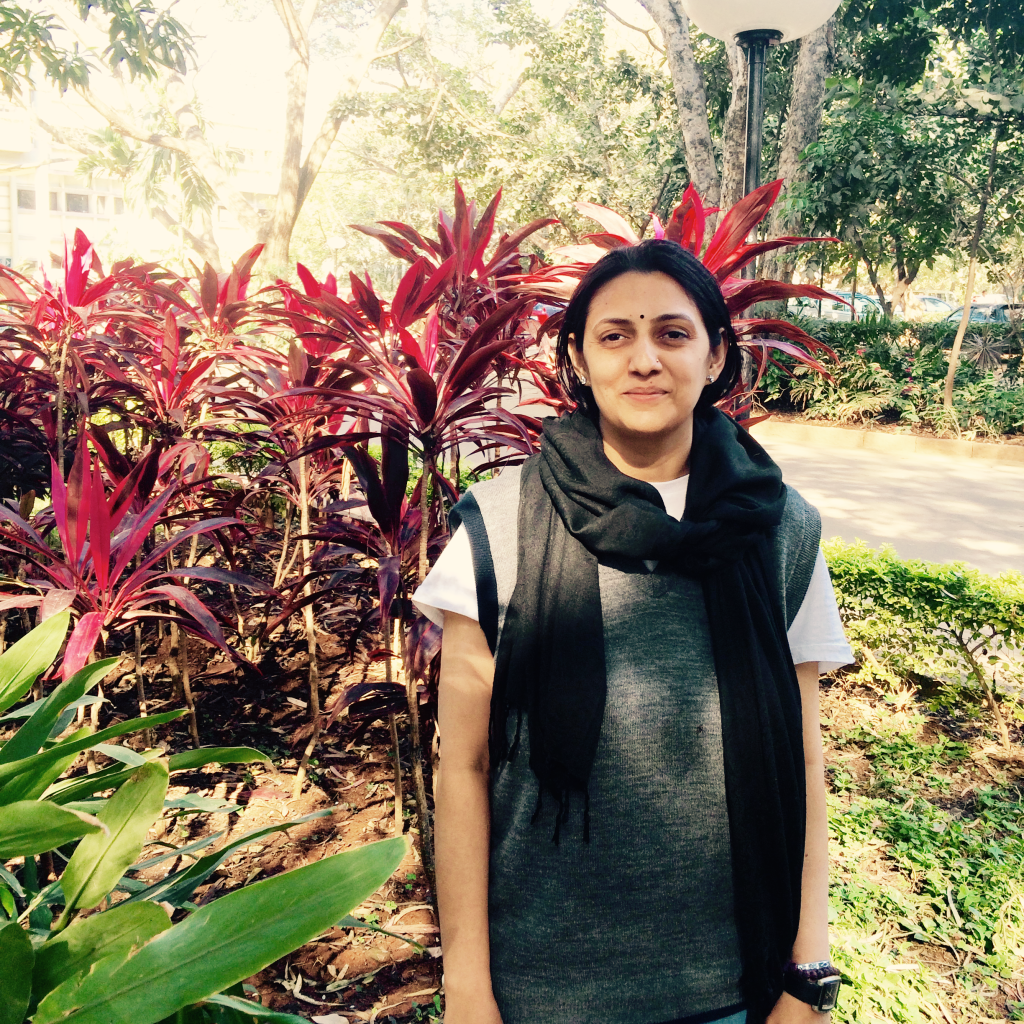
A Warm welcome to Dr. Pavithra P. Nayak, who has jointly joined the NICE group as well as the lab of Dr. Uma Ramakrishnan at NCBS. Pavithra will be working on interaction studies of Rhododendron across elevational gradients in North-East India from an ecology and evolutionary perspective. She has joined our labs as part of the NER-DBT program. We are so excited to work with her!
Snapshot
Trading stories at the “Women’s Empowerment in a Globalized World” Workshop (see http://nice.ncbs.res.in/2015/11/25/women-in-science/)
#IICF2016
Speaking about Santosh, Sriraksha, and Hinal’s research at the India International Coffee Festival in Mumbai today!


 NICE
NICE 