Maggot dreams

by Cheyenne Tait – When you’re joining a lab that focuses on a species complex of non-model univoltine insects, which are largely interesting because of the geographic patterns they exhibit, one thing should be obvious: the need for wild-caught insects to be collected from the field each year. For some reason, when I started studying Rhagoletis, this did not seem like…

Food for Thought

img_20151216_231820

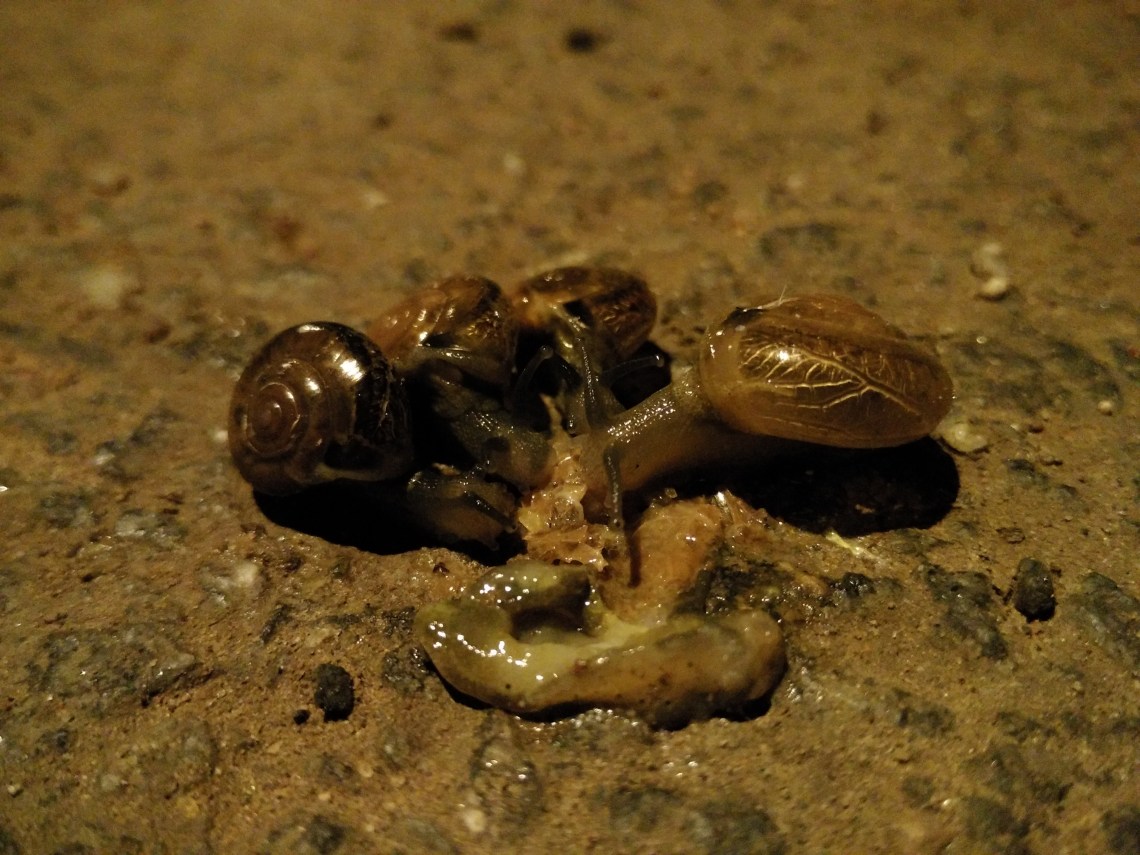
by Pavan Kaushik – Roadkill is touted as the most ethical way of eating meat.  But is cannibalism ethical? I am not sure,  but one thing is certain; snails love road kill and they don’t care about being cannibalistic either. The image explains the story. One light polluted night, in one of the residential streets of urban Bangalore, norms were being broken and snails were crossing the road. The answer to why the snail crossed the road is unclear, but it ended in a crunch.  A little while later, another snail decided to cross the road but got distracted by its dismembered conspecific. Curious the way he is, he decided to investigate the matter.  The investigator concludes, “Cannibalism isn’t such a bad thing, after all, it is road kill”. While he indulges in activities which are considered taboo, the silence is broken. Is this the punishment for breaking taboos? Completely impervious to the events that had unfolded, another snail gets itself involved in the dangerous act of crossing the road. Not only does it decide to cross the road but also decides to be curious. Curiosity killed the snail and this positive feedback loop goes on. When the silence is no longer broken by crunches but by chirping of birds, the loop breaks. At the rise of dawn, the curious and the uninterested do just one thing; take cover from the sun. Few hours from now, the entire story repeats itself.Amidst all this, one can ask many things.  Is this behavior specific to snails? Based on my personal observations, the exact same phenomenon occurs with squirrels on highways. Anecdotal evidence from others exist recounting similar stories with other rodents. These organisms predominantly feed on detritus, fruits and seeds and very rarely meat. Then why would they indulge in opportunistic carnivory (scavenging)? What could be the proximal and ultimate explanations for this behavior? What is the sensory basis of this aggregation behavior? Is this an artifact or is there a meaning in this madness? Understanding this might provide insights on decision making and may answer the long standing question of why did the snail cross the road?

Xenopus oocytes: Single cell model to study insect olfactory receptors

Xenopus laevis, image taken from wikipedia


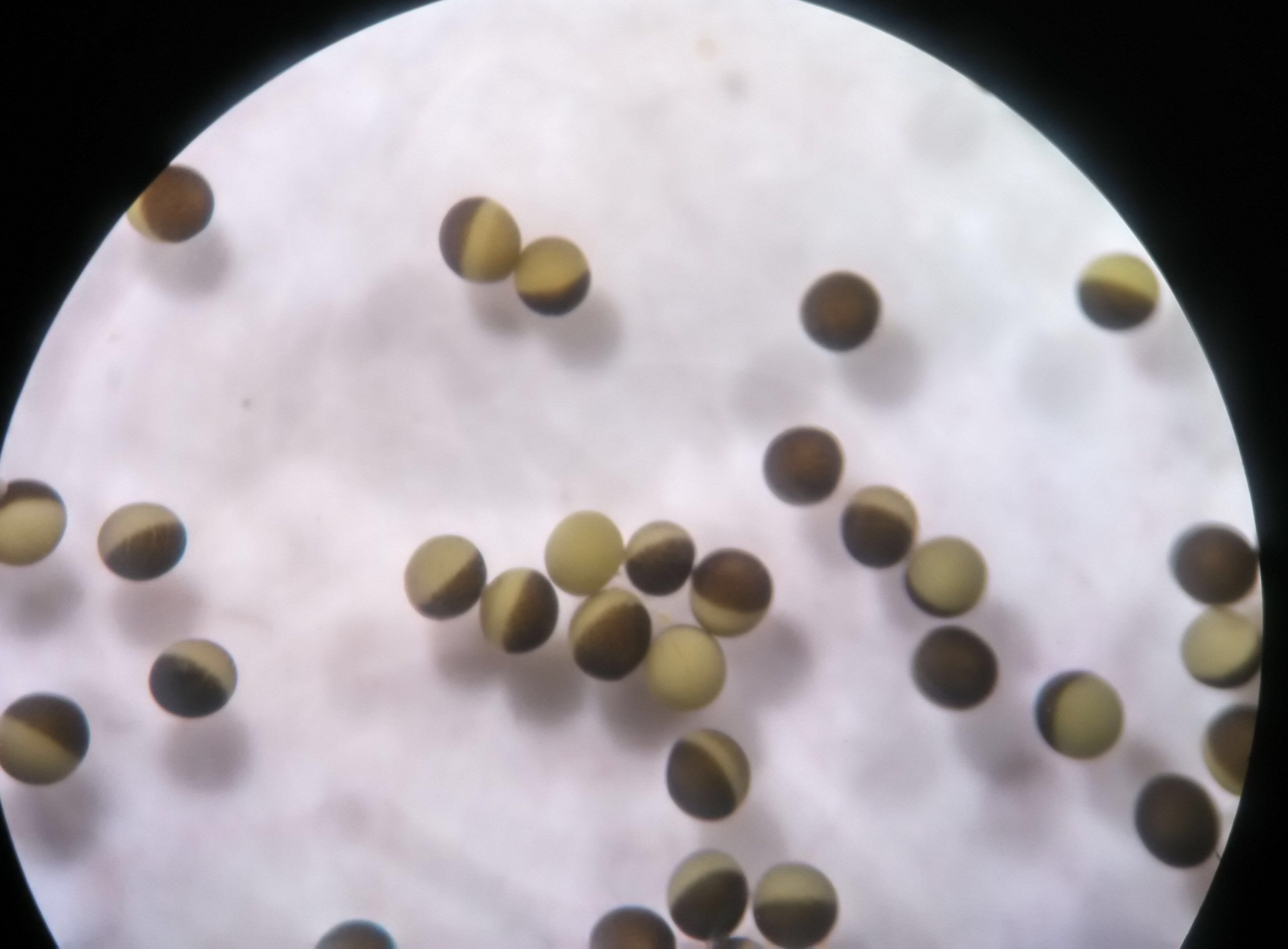
by Srishti Batra – Xenopus laevis is an African species of aquatic frog. These slimy creatures are a great model system for developmental biology, cell biology and physiology. Their oocytes are as big as 1mm, and molecules can be easily injected into them. They can translate exogenous mRNA into proteins, but don’t perform DNA replication. This makes oocytes a very well-known system for heterologous expression, that is, mRNA from different species is injected into them, which then gets translated into functional protein. This is the reason that they are also famous as a protein synthesis factory.

Xenopus oocytes


I have been using this system to study channel properties of insect olfactory receptors.  Xenopus is evolutionarily quite distant from insects, but when mRNA of insect ORs is injected, the functional protein is translated. Once the protein is available, we can study its ion channel properties using electrophysiology. Presently, I am setting up the two electrode voltage clamp technique to study heterologusly expressed insect ORs in xenopus oocytes.

Where are the pollinators?

electronic city

Electronic City, Bangalore

by Geetha GT – In the PLOS ONE article “Urban warming derives insect pest abundance on street trees”, the authors suggest that there may be more pests in cities than in rural areas because cities tend to be hotter. But I would like to add along with warming effect, air pollution also plays an important role. Are polluted areas and warm environments favorable for pests? And why are there no pollinators or predators that feed on pests? Is pollution and heat bad for pollinators and predators? Or can pollution and heat cause the pests to have more offspring? Or are these pests are adapted to live in a polluted environment? Still with no appropriate answer.. all these important questions need to be answered. According to preliminary results from our lab, air pollution is having big effect on insects in general (bad for pollinators and predators but good for aphids, and hoppers!). But WHY do certain insects do well in polluted areas??

What the NICE lab taught me

by Ajay S – Who said that laboratories and research studies are boring ? Believe me, you won’t feel that when you are working in the NICE lab. NICE lab gave me answers to the questions that have been in my mind for several years. During my summer internship period in NCBS with NICE lab members, I came to know what the research field is all about. I saw people working on projects that are fundamentally challenging the assumptions in their field. I saw people with huge devotion and irrational love for research. I saw how a lab works successfully, and I was wondered when I came to know that this lab is just one and half years old. I saw a lab working in diverse topics, united by the common thread of ecology. I saw how a P.I can be so nice and helpful. I realized how research is different in a way that you have to be constantly updated, reading papers and articles, learning new techniques, attending seminars and conferences, and so on.

    The NICE lab taught me the basic ideas of research. It’s research, it takes time, you need to employ new ways to solve the problems, you will be pushing the boundaries of knowledge and things look ‘impossible’. You must have the intellectual curiosity to know more things. You should have the creativity to design a whole new work-plan for your research. Most importantly, I understand the role of science communication. It’s important for scientists to be able to communicate the science to general public. Even though scientists are generally trained in all research methodologies and analytic skills, they fail to communicate the scientific concepts to other peoples. Shannon is such a wonderful P.I who gives the opportunity to everyone to showcase their analytic and communication skills. Because of that, I am writing the first blog in my life and that too for such an awesome chemical ecology lab. I am pretty sure that all this will be a great boost for my future career.

    I worked on the project named ‘chemo-visual ecology of hoverflies’. It was a great opportunity for me to work in this big project. At the beginning itself, Shannon told me that it will be a fun project. It’s a true ecology project where their final aim is to preserve and promote ecologically important wild pollinators and thereby increase the pollination. For two months, I felt like I was a naturalist, working hard to solve an environmental problem :P. And, now feeling like a published blogger!

Pseudocopulation

by VS Pragadheesh – One evening, Suhrid and I were walking in the field searching hoverflies. We didn’t find any hoverflies that day, but I saw an interesting behaviour: pseudocopulation in Hymenoptera. I recalled the article by Figueiredo et al., where I first learned about the term ‘pseudocopulation’, “Factors affecting secondary metabolite production in plants: volatile components and essential oils” (Flavour and Fragrance Journal, 2008, 23: 213-226). This is the article that made me curious about the ecological aspects of plant volatiles and drove me to  work on Chemical Ecology.

Another exciting thing is, pseudocopulation is mostly studied in Orchids. This is first time we observed this behaviour in Crotolaria.  More to come!

The walking stick

IMG_20160418_113317764by Sriraksha Bhagavan- Here is the beautifully camouflaged stick insect that freaked me out while I was searching for a beetle on a coffee plant. This was my first encounter with a stick insect!! As I moved closer to the insect, it moved to and fro rhythmically, pretending as if it were a twig swaying in the wind (this strategy helps in confusing its predators). It made me appreciate the difficulties its predator would have to face in order to spot this guy visually. Also, these creatures disprove the famous expression that it takes “two to tango”, as the females have the capability to continue their progeny without the involvement of a male (also known as parthenogenesis).IMG_20160418_113400876

As I observed this insect for a while, I was left behind with a question as to why nature conferred the ability to camouflage only to certain species.