Listen to nature’s language

_mg_0779

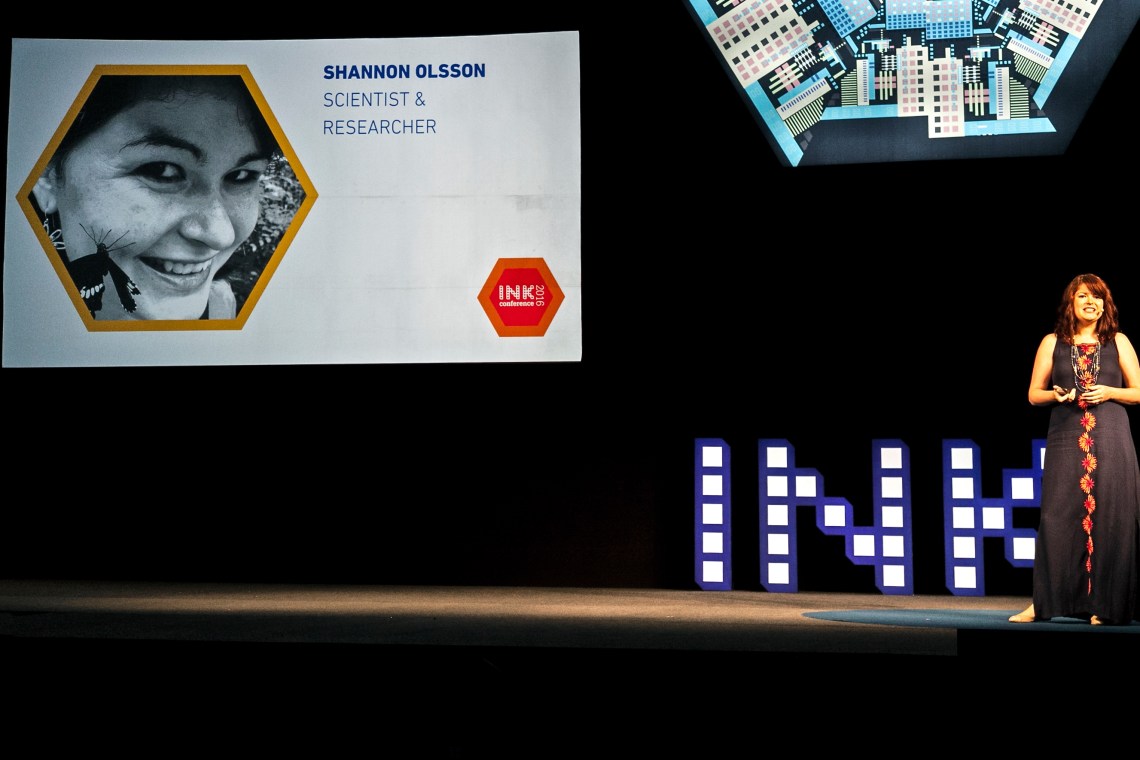
Here is the INK Fellows talk that Shannon gave at INK2016 in Goa, India, September, 2016:

Ecologist, Shannon takes the audience through the biodiversity of the nature around us and how, all life, from the smallest bacteria to the largest elephant, uses unique chemicals to communicate with each other and with their environment.

Source: Listen to nature’s language

NCBS Open Day!

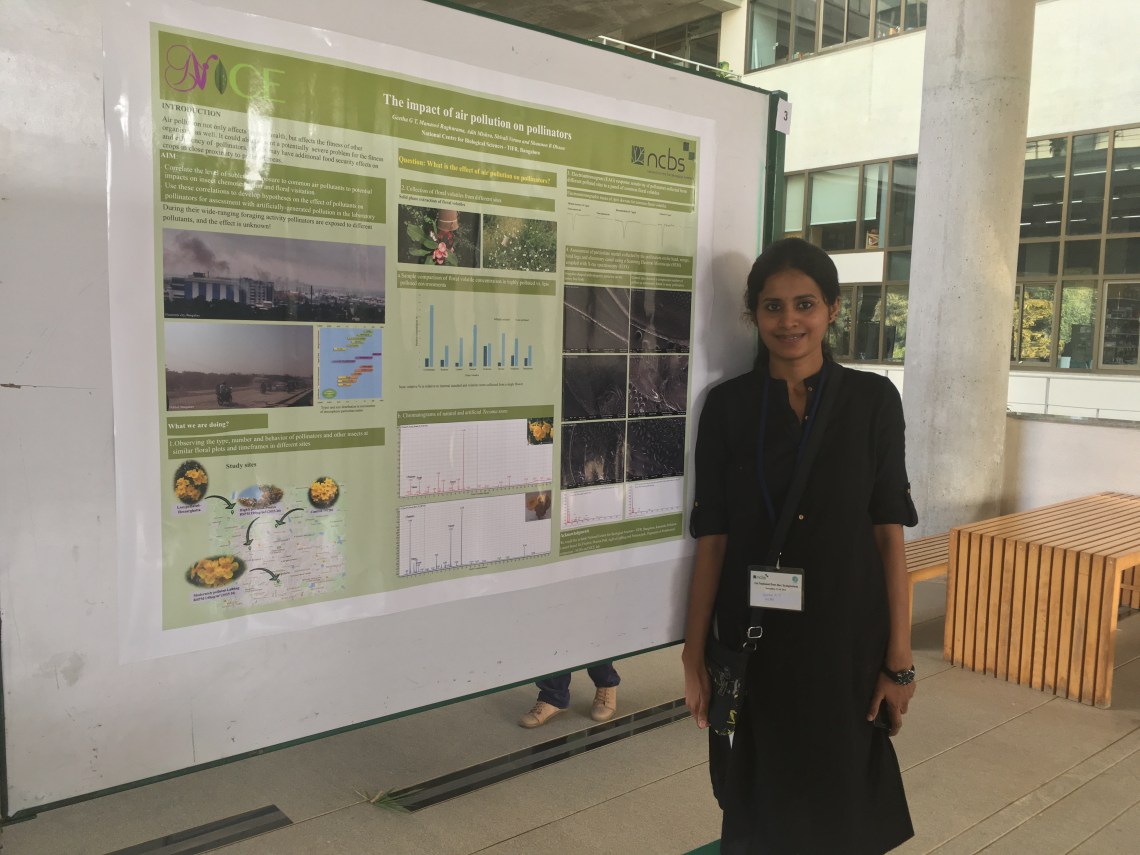
On Saturday, November 12, NCBS held an Open Day for the public to learn who we are and what we do.  The NICE lab was there, showing off the amazing abilities of insects to smell, fly, and locate objects.  Here are some images of Srishti, Hinal, Pavan, and Geetha hard at work sharing their passion for science with electroantennograms, artificial 3-D printed flowers, and virtual reality!

Should we ban vertical videos because humans can’t fly?

img_20150713_094138_vertby Pavan Kaushik – Vertical videos are shunned by all self proclaimed net-activists. Why would it be so? A few seconds of thought and we would conclude it’s a result of geometry. Standard video playback devices are landscape-oriented and vertical videos are essentially portrait. And since videos are rectangles and not squares, you can’t superimpose a rotated rectangle onto itself, unless you scale it down. But this would result in wasting screen real estate.

If we agree that that this is the case, we would naturally end up asking the next question. Why are most display devices landscape oriented in the first place? Is it because we write horizontally? Most languages on earth barring East Asian scripts such as totegaki, zongpai and others, are written horizontally. This seems very unlikely by chance, as scripts have originated multiple times in history. What is the reason for the predisposition for most languages to be written horizontally? Looking at the outliers might help us a bit. Japanese, for example, has every character conveying a disconnected idea. This is unlike letters or words in most other languages. It is more like phrases and ideas in a single square block of space. And these independent ideas come together to make a sentence. So, this can be written vertically or horizontally without much hassle. But, scripts like Latin or Devanagari, bead multiple letters to form a word and multiple words to convey an idea. And since we relate to ideas far more than syllables, as syllables are just the means we use to convey meaning to arbitrary combinations of scribbles and sounds. Being capable of understanding the idea in “one go” is convenient, to say the least.

What makes horizontally aligned items easy to read in “One go”? When you look around, one would realize that it is biology. The aspect ratio of our eyes is clearly biased towards the horizontal orientation. And our two eyes are placed horizontally. The geometry of our neck also lets us see far more horizontally than vertically. Pause. Look around, you will see that you see so much more horizontally. And if you notice, it is not just us, most terrestrial organisms are that way. Are the eyes HORIZONtal because of the horizon? If you look at the life history of these terrestrial animals, they have more relevant things to see on the ground than the sky, be it their prey or predator.

But what about organisms who have relevant things in the z direction too? For example, arboreal animals have eyes that are round, unlike ours. But they still have horizontal eyes. Can we run away from the question by saying that it is due to phylogenetic constraint? There are flatfish of the seas who also have very relevant things in the vertical direction. They have moved their eyes to the top, to not waste an eye. Then our best bet to is to look to flight where information from z is a necessity. The pioneers of flight, insects; what do they do? Since they are widely separated from humans in evolutionary time, they have a completely different vision system. And their eyes cover almost all directions. Yet, birds, on the other hand, suffer from the same phylogenetic constraint. Life came on water, then land. The air was conquered last, probably because it needed so many things to be just right for it to be a viable next step.  So, is (lack of) flight the reason why we can’t look beyond the horizon and are limited to the ground? And to make best use of land, we have horizontal eyes, thus making it is easy for us to read horizontally.  And our devices end up fitting our eyes. Does this make vertical video something to look down upon? How would one test this story? I’m not so sure.

Diwali – Festival of air pollution?

diwali_geetha1

by Geetha GT – Diwali, which marks the Hindu New Year, is celebrated with a riot of fire crackers across the nation. On the other hand, air pollution in Bangalore increased to terrifyingly high levels during Diwali celebrations this year. Thick smog suspended low in the air on Diwali night and for a few days after also. While we ignore the odor – and some people even claim to like it – we can’t overlook the fact that we (including all other living organisms) are inhaling toxic air. Diwali can thus be hypothetically deadly for one and all! diwali_geetha2

This year Bangalore already has a lot to worry about with the Air Quality Index elevated to the ‘Moderate’ level and PM 2.5 (Respiratory Suspended Particulate Matter- RSPM) going up to three times more than the safe limit. One Diwali night might cause as much impairment to the environment as regular pollution does over the entire year! The time is ready for change. But for that, we need to be free of our selective amnesia about pollution. This is not a matter we can challenge only around Diwali. It requires year-round intervention.

What we can learn from nature?

by Marian Renz – Ever heard of Biomimetics? Let me give you a short introduction: Biomimetics is a relatively new, interdisciplinary field of science. The Spirit: learn from nature. Understand how things work. Then, copy your findings into a technological application. Create applications, which “mimic” the nature.

That could be the body shape of a fish, allowing an autonomic underwater vehicle to do more complex maneuvers under water. That could be the gate of a cockroach, providing robots a stable movement in uneven terrain. That could be the fiber structure of a plant stem as a model for fiber reinforced plastic.

But from an engineer’s perspective, why should we use that approach with nature? Well, the idea is that the answer for every question is already given. After millions of years of evolution, organisms “developed” a solution for every problem they had. Survive under extreme conditions, show incredible biomechanical abilities, foraging with minimum effort of energy; every organism has its ability to survive the challenge of competition. They already found the solution to their special problem. And we can use that.

Everyone has his or her particular view of the world. Entomologists see the insects around us; fluid dynamic people have an eye for smoke paths or the streaming behind a boat. I see small dragonfly-planes flying around and ant-cargo-companies managing their ware shipment.

So the question never was “Can we learn from nature?” The question is: “What can we learn next?”

NCBS is 25!

On Saturday October 22, our campus celebrated the 25th anniversary of NCBS. The NICE Lab was there with a roti stall, and Geetha’s beautiful SEM image of the “bee’s knees” was featured in the colonnade. There was also a special performance by the campus crèche, Dolna, and even a skit by the faculty featuring a mysterious cowboy…

Even a plant should look pretty to get its job done!!

by Sriraksha Bhagavan – Poinsettia is an amazing and  beautiful plant.
For many pollinators and nectar feeders, this plant is a good place to dine in. The interesting feature of this plant is that during the flowering season, the leaves of the Poinsettia undergo modification to look like a flower, and the so-called petals of the flowers are actually the modified colorful leaves,called bracts.  The actual flower is the yellow nectar filled cup-shaped structure which lies in the center of these bracts. This modification is essential to Poinsettia as it is a short photoperiod plant, and it flowers generally during Christmas time where the length of the day is comparatively shorter than the nights. Therefore, this plant has to get its job(pollination) done faster. Hence, to attract pollinators, the leaves become colorful and the flower secretes nectar during flowering season. And just look how many different kinds of insects visit this plant, be it a fly, wasp, honey bee, ant, butterfly or a bug! It looks like every insect wants to make a visit to this plant, and not just pollinators. There are also silent predators like the preying mantis, crab spider and jumping spider, waiting to grab the pollinators when they are busy feeding.

And this makes me wonder, what a great loss will it be to our ecosystem if we lose a plant of this kind!
It would be good if we could have these kind of plants in our gardens or backyards as they make our garden look pretty and also would create a tiny shelter for these cute little insects. (Until and unless you don’t freak out seeing so many them!!)

In Remembrance of the Three Musketeers: Whity, Browny and Naughty!

Three Musketeers.JPGLife in field can sometimes be very lonely! But mine was exciting all the way because of the three musketeers: Whity, Browny and Naughty. They were three dogs who I got friendly with during my period of work at field. They were always happy to accompany me as I walked inside the coffee plantation alone, and they would constantly look out for danger and protect me. During my stay, they warned me thrice of the approaching elephants. One night, when an elephant came outside my house to feed on jackfruits and bananas, they stood outside the house, brave and bold! To them, the elephant was just a big cow grazing. When I would work on my experiment, they sat outside waiting for me for hours till I finished. Everyday, they waited for my return from field, faces beaming with happiness, excitement and expectation; and always gave me company when I ate my dinner.

brownyThey definitely made a huge difference during my field work and I am writing about them because I recently got to know that they are no more. Their stories of staying with me and protecting me, when the elephants were hardly 10 meters away, guarding the field setup for hours, and above all, showing unconditional love to a complete stranger (me), is something which needs to be told and remembered always.

whity