Futures in Biology – NCBS Annual Talks
Shannon was so honored to be part of YETI (Young Ecologists Talk and Interact) 2017 at Tezpur University, Assam. So many amazing young and enthusiastic scientists. Shannon was blown away by their passion and enthusiasm! #YETIrocks @meet_yeti
by Santosh Rajus – Eight years back, I planted a few trees in my home compound with the hope that I could make a small difference in my hometown. These trees included a fig and a guava tree.
What a joy it is to see these trees filled with life, both during the day and night. What captured my attention was the sighting of the Flying Foxes. I have always noticed them fly over my home in search of food, but how did they find this new tree which has only come up recently?
It is known that they use smell to find food, but from how far can they smell and find their food? Do they navigate and find their food source based on smell first, or is it based on visual guidance or do they just randomly hover over plants and find their food source? Everyday, I am fascinated by nature and its ways!
Do keep planting trees, because every tree you plant today will make a difference in the future!
[Note: This article reflects the viewpoint of the author and not necessarily the NICE Group, NCBS, or TIFR] by Shannon Olsson – The issue of climate change has become a daily talking point and political lightning rod across the world. Regardless of its root causes, our climate IS changing. Many regions are experiencing more extreme weather, longer droughts, hotter summers, and a…
Recently Shannon had the wonderful experience of speaking at an INK Salon as part of Manipal Global’s NxtGen Summit in the Seychelles. It was wonderful to meet all of the attendees and discuss how India can be a leader in the 4th Industrial Revolution. You can hear about Shannon’s experience here

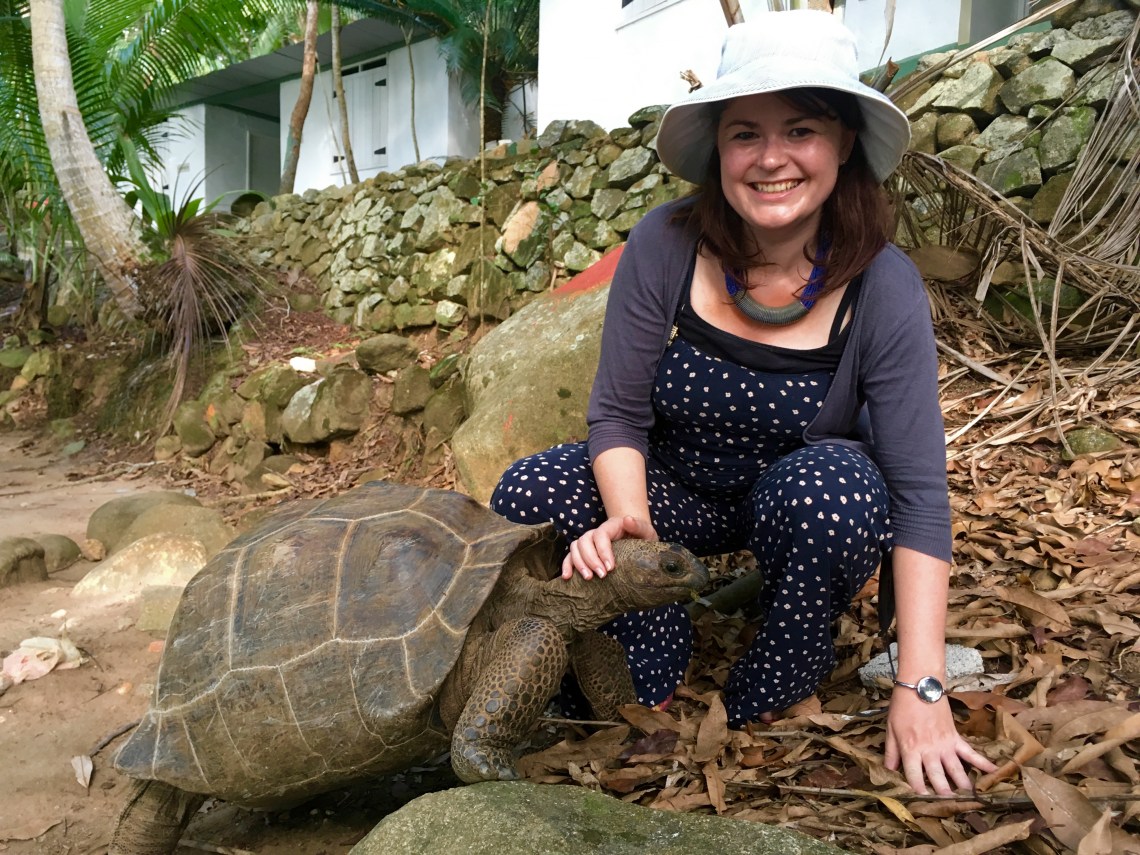
Shannon with a giant tortoise in the Seychelles
by Hinal Kharva – As a part of our chemical ecology course at NCBS we had an opportunity to go on a nature walk with Dr. Uma Shankar from Gandhi Krishi Vigyan Kendra (GKVK). From my personal interaction with him, I could say he is one of the scientists who can develop a curiosity driven passion in almost every student.
In this session, he introduced us to one of the important plants of the silk moth’s life cycle (and thus most important in silk production), mulberries. We started our walk in mulberry plantations at the sericulture department (located within GKVK Campus). Interestingly, this is the only place in their campus where they don’t spray any insecticides or pesticides on these plants. The leaf of this plant is food for the silk moth (Bombyx mori), which are actually reared in the lab. In fact, due to heavy domestication, silk-moths are no longer available as a wild species! Here starts an interesting part. Insects other than the silk moth cannot feed on mulberry leaves. And do you know why? Mulberry leaves have a defense mechanism against insects, the production of latex (Milky liquid). Latex contains high concentrations of alkaloids, sugar-mimic glycosidase inhibitors. These inhibitors do not allow the further breakdown of sugars in most insects.
Studies have identified a latex protein called “MLX56”, which defends against several insects but not the silk moth. How does the silk moth deal with this latex? The silk moth has developed a strategy to avoid these glycosidase inhibitors, mainly by using an alternate fructosidase pathway. Fructosidase pathways are generally present in bacterial systems. The silk moth has evolved and adapted these pathways, and this is how it has become specialized on mulberry plant.
When we visited these plantation we did see hoppers, preying mantis, beetle, bugs and several other insects on the leaves but none of them were eating the leaves. This is one of the beautiful examples of plant-animal interactions that I learned during the nature walk. I am waiting for my next nature walk to learn new fascinating interactions and tell you some more interesting stories.